
Press kit.
Everything needed to write about Piqt: copy you can lift, assets you can publish, and a review code on request. If something's missing, email and it'll be sent the same day.
Fast facts
- Name: Piqt (pronounced "pict")
- Developer: 8twist LLC, an independent two-person studio
- Platform: iPhone and iPad (iOS 18 or later) and Mac (macOS 15 or later). One purchase covers all three
- Released: 20 August 2026
- Latest: 1.2.0, a native Mac app and optional iCloud sync. Scores and decisions move between a user's iPhone, iPad, and Mac through their own iCloud, end-to-end encrypted, and Piqt never uploads the photos themselves. The 1.1 line before it finds and names trips and events on-device and cuts each one down to an album in Photos
- Price: Free to scan, score, and browse. Piqt Plus unlocks actions at $3.99/month or $29.99/year (7-day free trial), $49.99 lifetime, or a limited $99.99 Founders edition
- App Store: apps.apple.com/us/app/piqt-photo-video-curator/id6778080898
- Website: piqt.app
- Contact: hello@piqt.app
Boilerplate copy
Use any of these as-is, no attribution needed.
One line
Piqt is an on-device photo and video curator for iPhone, iPad, and Mac that scores your whole library, surfaces the shots worth keeping, and clears the rest without ever deleting anything itself.
Fifty words
Piqt scores every photo and video on your iPhone, iPad, or Mac entirely on-device, ranking your best shots, grouping near-identical frames, and filing screenshots. Every score is explainable in a detailed score sheet. Piqt respects your privacy and safety: your photos are never uploaded and Piqt can't delete anything by itself, so you're in control.
One hundred and fifty words
Piqt is an on-device photo and video curator for iPhone, iPad, and Mac from independent studio 8twist LLC. It scores every photo in a library across five signals — Apple's aesthetic model, technical quality, a NIMA model trained on 255,000 human-rated images, the faces in frame, and how rarely the photographer shoots in that location — then sorts the library into shots worth keeping, categorized screenshots and utility images, near-identical frames worth thinning, and clutter worth clearing. It also notices trips and events from the photographer's own habits, names them from an on-device place table, and turns each into an album in Photos.
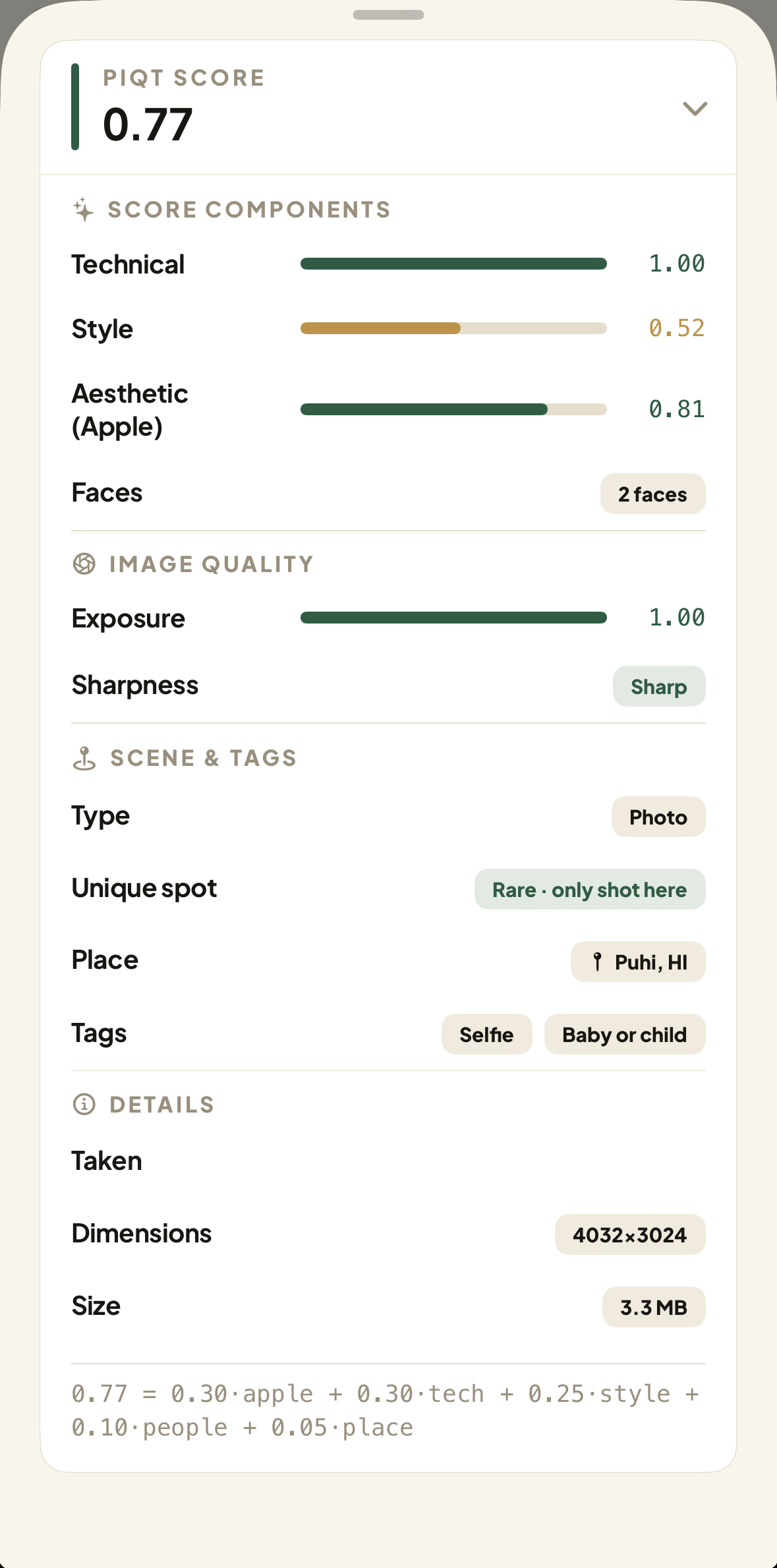
Every score opens into a sheet showing each signal, each penalty, and a plain-language explanation of why a photo landed where it did. All five weights are user-adjustable, and the library re-ranks instantly without a rescan.
Everything runs locally. No account, no photo upload, no cloud processing. Optional sync carries scores and decisions between a user's devices through their own iCloud, end-to-end encrypted. Piqt has been tested on libraries up to 100,000 photos, and the initial scan is batched and resumable.
Four angles worth writing about
1. Quality ranking, not duplicate detection
Most photo cleaners find duplicates, screenshots, and large files, then measure success in gigabytes recovered. Very few will tell a user which of their photos are actually good. Piqt ranks on quality first and treats cleanup as a consequence, which is a fundamentally different product shape from the storage-recovery tools that dominate the category. This is why we classify Piqt as a curator, as in a museum curator, rather than a paper shredder.
2. Explainable scoring in a consumer app
Tapping any score opens a breakdown: every signal, every penalty applied, and a written explanation of why that photo landed where it did. All five weights are exposed as sliders, and the library re-ranks instantly without a rescan. Consumer AI features are usually opaque by default; this one argues its case and lets the user overrule it. Today we have five weights and will continue adding and refining them as we develop the app. Our goal is to understand what makes you love a photo so that we can find it and surface it for you.
3. Genuinely on-device, secure, and safe by design
All scoring runs locally with Core ML and Apple's Vision framework using the accelerators on Apple silicon. Therefore, there's no account, no photo upload, no cloud inference needed. Optional iCloud sync between a user's iPhone, iPad, and Mac is end-to-end encrypted, goes to their own private iCloud database rather than a Piqt server, and never carries photos. For additional security, sensitive data found in screenshots and documents (SSNs, account numbers, etc.) is scrubbed from in-app data. We never connect to external location services to fill in place names — those come from a gazetteer bundled in the app — and we only ever store a one-way hash of that match, never the name or your coordinates. Nothing Piqt does to a library is permanent either: cleared photos are staged in a "Piqt: To Delete" album and the actual delete happens in Apple's Photos behind Apple's own confirmation dialog. That constraint is enforced in code — the deletion API appears nowhere in Piqt's source, and an automated test fails the build if anyone adds it.
4. Trips found and named without a location service
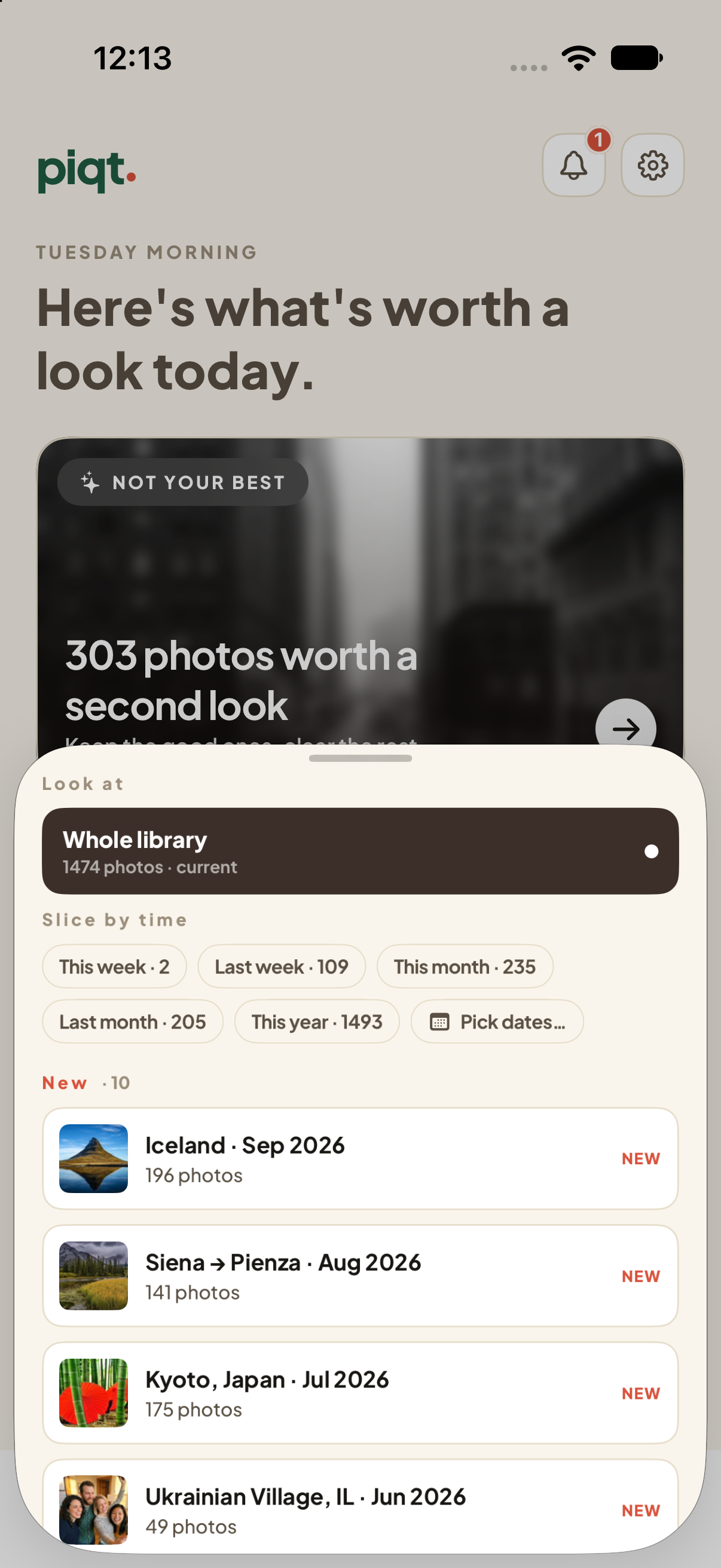
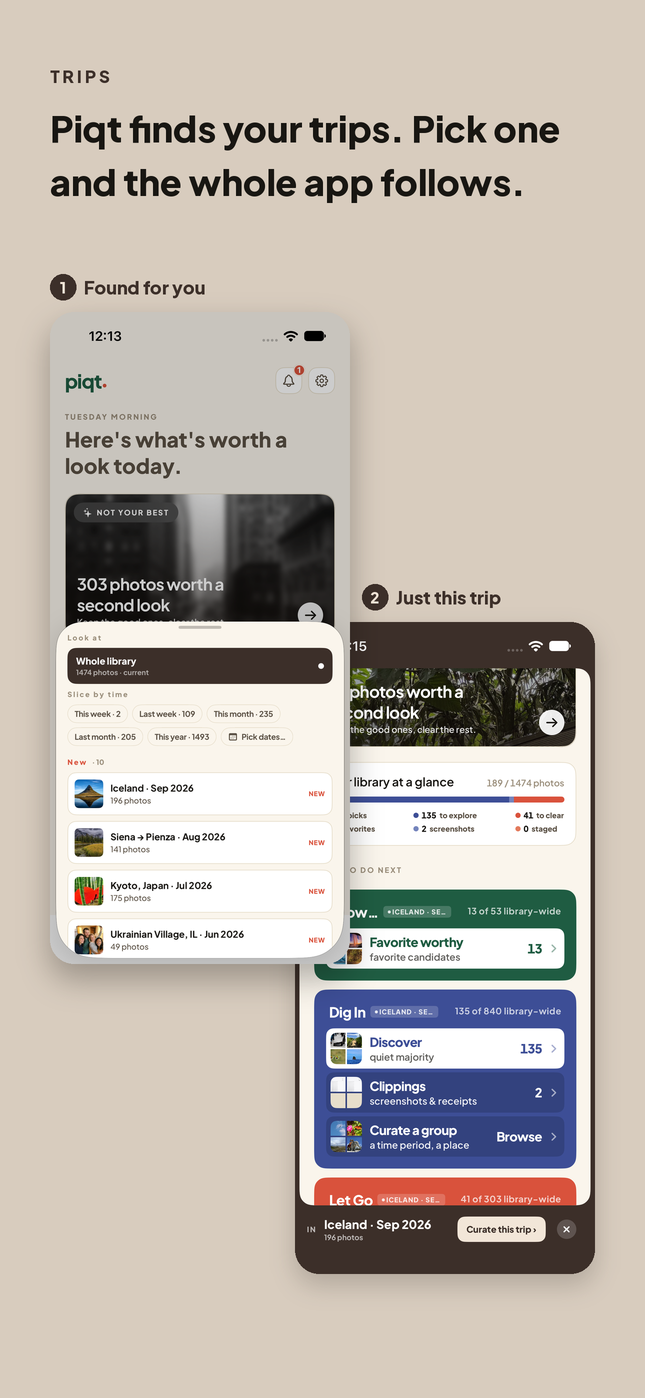
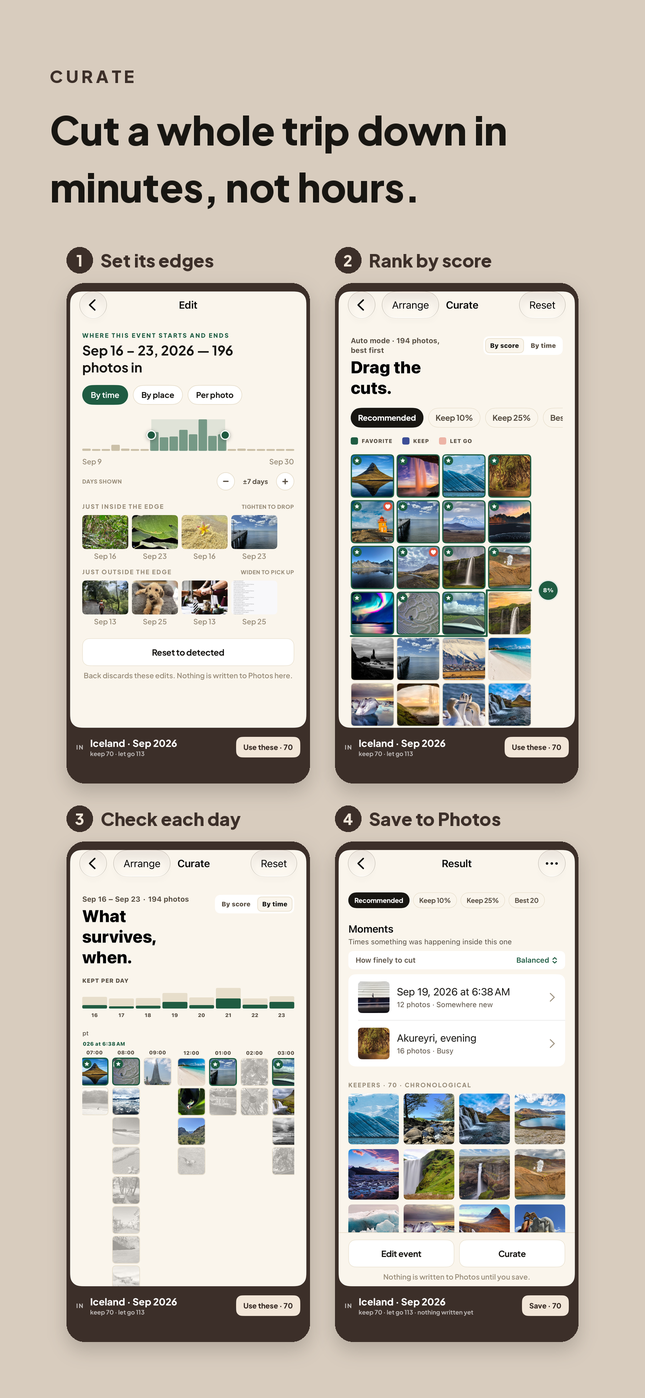
Piqt 1.1 finds a user's trips and events by watching for changes in their own shooting habits: a burst of photos over a couple of days, or a run of shots far from home. Each trip is named for where it happened, from "Kyoto, Japan" to a two-stop route like "Banff → Calgary", using a GeoNames place table bundled inside the app and looked up on the device. No reverse-geocoding call is ever made, Piqt holds no location entitlement, and a build-time test keeps it that way. Inside a trip, every Piqt workflow runs against just those photos, and the Recommended cut keeps at least one shot from every day and every moment, so the album that lands in Photos never loses the only picture from a quiet afternoon.
Assets
All images are free to publish in coverage of Piqt.
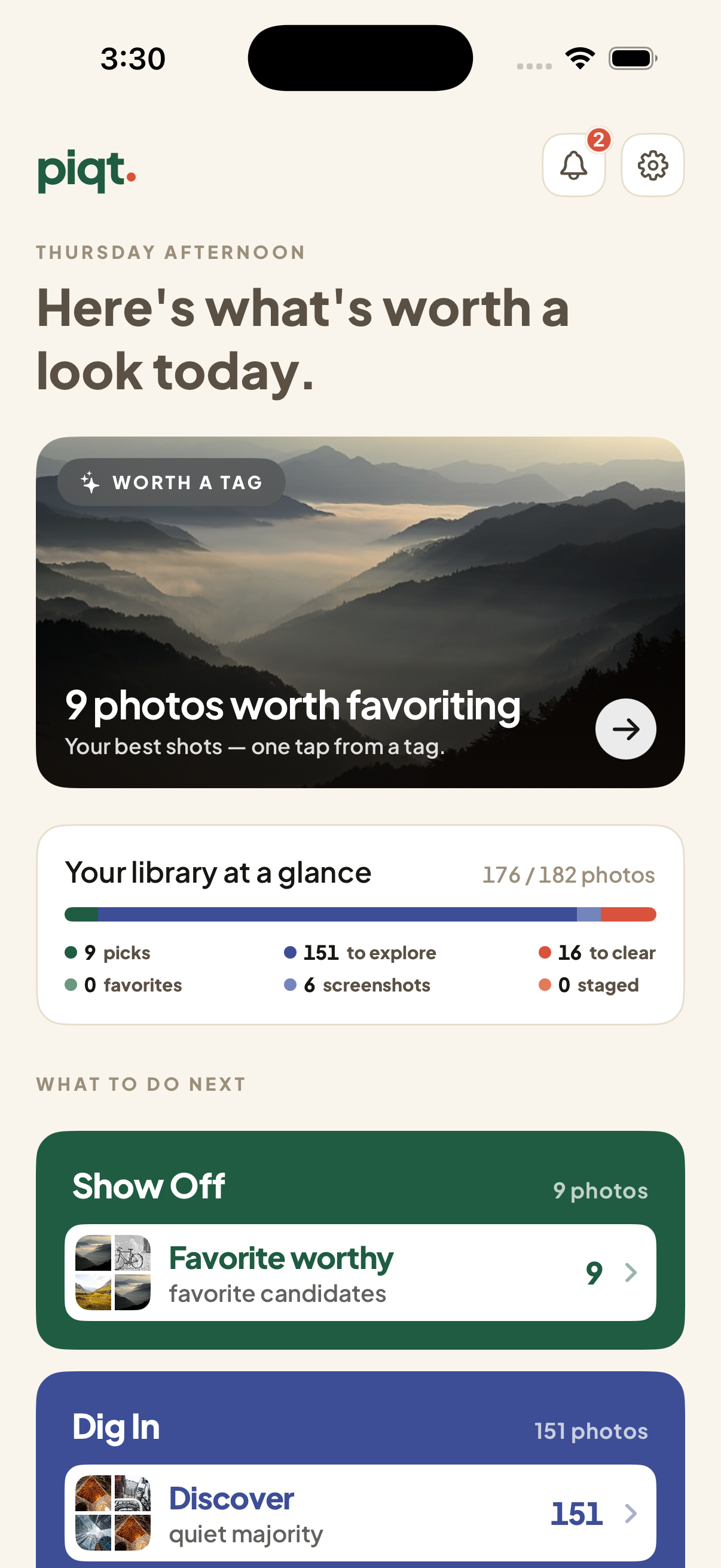
- Dashboard screenshot — the home screen, buckets, and counts
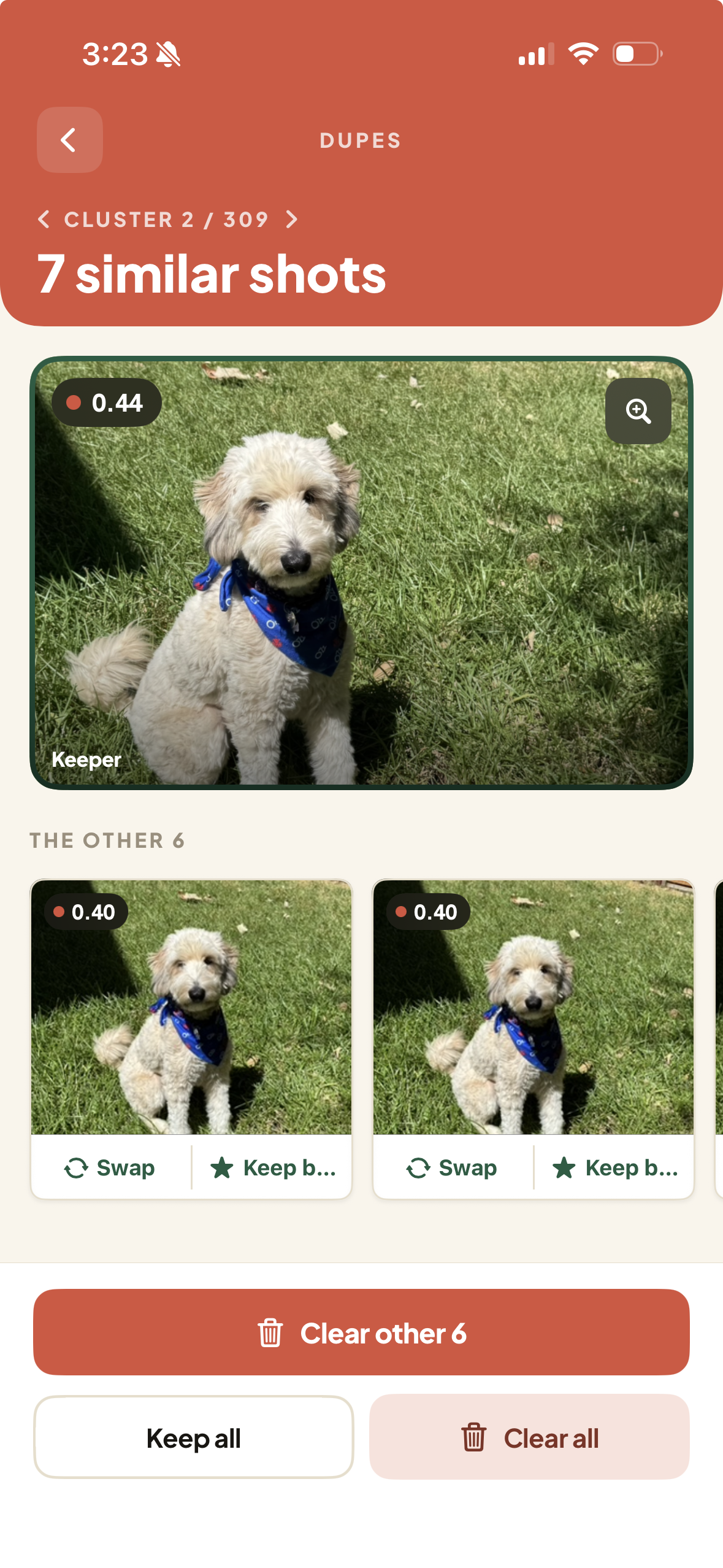
- Dupes screenshot — side-by-side keeper comparison
- Score sheet screenshot — the per-photo signal breakdown
- Lens screenshot — the trips and events Piqt found, named by place
- Trips card — App Store card, 645×1398
- Curate card — App Store card, 645×1398
- App icon
- Social card — 1200×630
- Tour video, 85s · MP4, 1280×720
- Trips video, 66s · MP4, 1280×720
- Mac video, 63s · MP4, 1280×720
- Mac video, 30s cut · MP4, 1280×720
- Tour video, vertical, 35s · MP4, 720×1280, for Reels, Shorts, and TikTok
- Trips video, vertical, 27s · MP4, 720×1280


Demo videos
Every cut is free to embed or excerpt in coverage of Piqt. All were recorded on Piqt 1.2. Self-hosted, no third-party player, and no tracking. Right-click and save, or email for the 1080p masters.
Tour · 85 seconds
Scanning, your best shots ready to favorite, the score sheet that explains each pick, the near-duplicates Photos misses, and video. The one to use if you only run one.
Download MP4 · 1280×720, H.264 · Vertical cut, 35s
Trips · 66 seconds
How Piqt spots a trip from a change in shooting habits, names it for where you went, breaks it into moments, and cuts it down to an album, day by day in the trip's own time zone.
Download MP4 · 1280×720, H.264 · Vertical cut, 27s
Piqt for Mac · 63 seconds
The whole library on the big screen: a grid sized to your display, bursts compared side by side, screenshots and receipts filed and searchable, and sync with iPhone and iPad.
Download MP4 · 1280×720, H.264 · 30-second cut
Review access
Piqt is free to download, so the app can be tried immediately with no code required. Piqt Plus, which unlocks favoriting, clearing, saving trips as albums, and video trims, is available to reviewers as a complimentary offer code. Email hello@piqt.app and one will be sent within the day, no conditions attached.
About the developer
Piqt is made by 8twist LLC. It's built by Steve Croce, a Product Leader with 20 years across hardware, software, data, and AI. He's also an experienced Python/C/C++ developer who came to Swift and SwiftUI specifically for this project. Piqt began as a Python research project into whether neural image assessment models were good enough to sort a personal photo library, and became an iPhone app once the answer turned out to be yes. The scoring pipeline was validated against human-rated benchmark datasets before a line of Swift was written.
LinkedIn. Available for interview, technical questions about the on-device pipeline, or a walkthrough. hello@piqt.app.
See also the Privacy Policy and FAQ.